

The 2026-27 BMSB season covers goods shipped on board between 1 September 2026 and 30 April 2027. If your goods come by sea from a target risk country such as the United States, Canada, Germany, Italy or Türkiye, and they fall in a target high risk tariff chapter like machinery, vehicles, steel or timber, they must be treated for brown marmorated stink bug before they can be released.
Goods from China, Japan and Korea are not on the target risk country list for goods. They can still be picked for a random inspection.
Most of what happens to your shipment is decided by three things: the shipped on board date, the country, and the type of container the goods travel in.
General information only, not legal advice. Every rule here comes from the Department of Agriculture, Fisheries and Forestry (DAFF) pages linked beside it, as published for the 2026-27 season (reviewed 19 November 2026). DAFF can change the measures during the season.
Key takeaways
- The season is decided by the shipped on board date on the ocean bill of lading, not the gate-in date. A sealed container packed and sealed before 1 September can be kept out of the measures with a sealing declaration.
- Four yes answers put a shipment in: shipped 1 September to 30 April, by sea, made in or shipped from a target risk country, and in a target tariff chapter.
- Target high risk goods must be treated. Target risk goods face random inspection only.
- Sealed six-sided containers can be treated offshore or on arrival. Flat racks, open tops and other break bulk must be treated offshore, or they are refused discharge or sent back.
- The Safeguarding Arrangements Scheme and the rolled goods policy are gone this season. Ethyl formate is a new approved treatment.
The dates, and the one date that counts
DAFF's rule is that the seasonal measures "will apply to targeted goods manufactured in or shipped from target risk countries, that have been shipped between 1 September and 30 April (inclusive)" (DAFF, Seasonal measures for BMSB). For this season, that is 1 September 2026 to 30 April 2027.
The date that decides it is the shipped on board date shown on the ocean bill of lading. DAFF says gate-in dates and times are not accepted, and neither is container tracking information. A container packed in late August that sails on 2 September is in the season, though if it was packed and sealed in a six-sided container before 1 September, a sealing declaration can take it out (see below).
Two more dates matter inside the season:
- 1 December. Treatments done offshore before 1 December come with a 120-hour post-treatment window. From 1 December that window no longer applies, and a new-machinery exception starts (both explained below).
- 30 April. Goods shipped on board after 30 April 2027 are outside the season, even though some will still be on the water in May.
| Date or event | What applies |
|---|---|
| Treated offshore in a target risk country before 1 December 2026 | The goods must be sealed in a container, or loaded on the ship if break bulk, within 120 hours of treatment |
| Treated from 1 December 2026, or in a country not on the list | No 120-hour window |
| New machinery made from 1 December 2026 (chapters 82 and 84 to 89) | Can skip treatment with the manufacturer's declaration |
| Shipped on board after 30 April 2027 | Outside the season |
The measures also reach the ships themselves. Roll-on roll-off (ro-ro) vessels, the ships that cars and machinery are driven on and off, get a mandatory seasonal pest inspection on arrival if they call at target risk countries in the season (DAFF, Management of vessels). That is a matter for the shipping line, not the importer.
Is your supplier's country a BMSB target risk country?
DAFF's 2026-27 list names 38 target risk countries for goods. It covers much of continental Europe, plus the United States, Canada, Türkiye, Russia, Kazakhstan, Uzbekistan, Georgia, Armenia and Azerbaijan. Goods "manufactured in or shipped from" any of them are in scope, so a German machine shipped out of Rotterdam and a US machine shipped out of Germany are both caught.
China, Japan and the Republic of Korea appear on the list with the words "heightened vessel surveillance only". That applies to the roll-on roll-off ships, not the goods on them. DAFF also names the United Kingdom, China, Japan and Korea as emerging risk countries: goods from those four may be selected for a random onshore inspection, and for them plastics (chapter 39), furniture (chapter 94) and toys and sporting goods (chapter 95) are added to the goods that can be inspected.
| Where the goods come from | What applies in the 2026-27 season |
|---|---|
| United States, Canada, much of continental Europe, Türkiye, Russia, Central Asia, the Caucasus | Full seasonal measures: target high risk goods must be treated, target risk goods may be inspected |
| United Kingdom | Emerging risk: random onshore inspection, no mandatory treatment |
| China, Japan, Republic of Korea | Emerging risk: random onshore inspection, no mandatory treatment. Roll-on roll-off vessels from these countries get a seasonal pest inspection |
| Everywhere else | Not subject to BMSB measures, unless the goods were shipped from a target risk country, or transhipped there under the conditions DAFF sets |
Check the full list on the DAFF page before you book, because DAFF reviews the measures during the season.
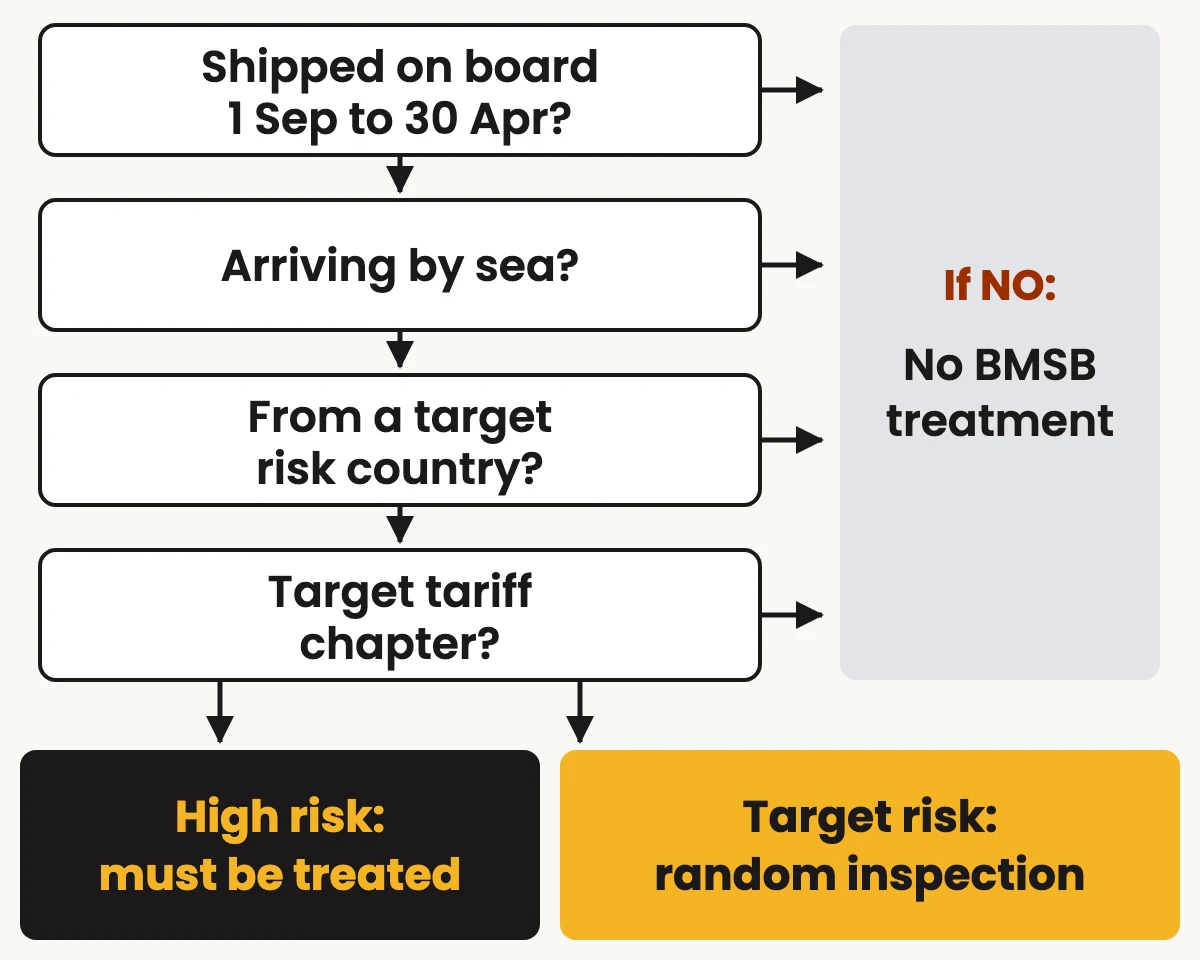
Are your goods target high risk, target risk or neither?
DAFF sorts goods by tariff chapter, the first two digits of the classification on your import declaration. The two lists are long, but the pattern is easy to remember: the high risk list is mostly metal, machinery, vehicles, timber, stone and glass, and the risk list is mostly chemicals, plastics, rubber, paper and rope.
| Tariff chapters | Category and what it means |
|---|---|
| 44, 45 (wood, cork); 57 (carpets); 68, 69, 70 (stone, ceramics, glass) | Target high risk: mandatory treatment |
| 72 to 76 and 78 to 83 (iron, steel, copper, aluminium and other base metals, tools, metal articles) | Target high risk: mandatory treatment |
| 84, 85 (machinery, electrical equipment); 86 to 89 (rail, vehicles, aircraft, boats) | Target high risk: mandatory treatment |
| 27, 28, 29, 38 (fuels and chemicals); 39, 40 (plastics, rubber); 48, 49 (paper, printed matter); 56 (twine and rope) | Target risk: random inspection, no mandatory treatment |
| All other chapters | Out of scope, unless packed in the same container as target goods |
That last line catches people out. DAFF says that if a container holds a mix of target high risk, target risk and other goods, the whole container is assessed as target high risk and needs treatment at the container level (DAFF, Preparing to import goods during the BMSB season). One untreated pallet of steel brackets from a target risk country, in a container of clothing, makes it a treatment container. Treat the brackets offshore before packing and the clothing is not affected. The rules apply to new and used goods alike, and to the goods only, not to their packaging.
If you are not sure which chapter your goods fall in, settle the classification first. We do that as part of tariff classification advice, because the same chapter drives both the duty and the BMSB category. Our guide to how import duty and GST are worked out covers the duty side.
Your container type decides most of it
Once the goods are in scope, the way they travel sets what happens next.
| How the goods travel | What DAFF requires |
|---|---|
| Sealed six-sided container (FCL, or FCX packed as a full container), including reefers and hard tops | Treat offshore, or on arrival at the container level. No unpacking before treatment |
| Shared container with other importers' goods (LCL or FAK) | Managed at the container level before it is unpacked. Without the consolidator's declaration the container is held at the wharf |
| Flat rack, open top, modified container, shipper-owned container, other break bulk | Offshore treatment is mandatory. Untreated goods are denied discharge or directed for export. No onshore treatment |
| Air freight | No treatment. Target high risk goods from the United States and China may be randomly inspected |
| Iso-tanks and bulk in the hold | Not subject to the measures |
Full containers. A sealed six-sided container with target high risk goods "can be treated offshore, or onshore at the container level" (DAFF). The goods stay in the container until treatment is done; a container that cannot be treated is directed for export.
Shared containers. In an LCL or FAK container, the BMSB risk is dealt with for the whole box before anyone's goods come out. The master consolidator lodges a declaration about the container. DAFF says that without it the container is held at the wharf, and if no declaration comes within 35 business days the container is directed for export (DAFF, Management of LCL/FAK containers). Your goods can wait on someone else's paperwork, which is why DAFF encourages treating LCL goods offshore.
Flat racks and open tops. These are break bulk, and the rule is strict: "offshore treatment is MANDATORY" (DAFF). DAFF also counts modified containers, such as those housing generators, filtration plants or site accommodation, and shipper-owned containers as break bulk. If you are bringing in an excavator, a tractor or a boat on a flat rack from the United States or Europe, the treatment certificate has to be right before it sails.
Shipping from a target risk country this season? Send us the commercial invoice, the packing list and the booking details, and we will tell you whether the goods are in, what treatment the paperwork needs to show, and what the clearance will involve.
BMSB treatment and fumigation: where and how it is done
There are two places to treat: offshore before the goods sail, or onshore after they arrive. Break bulk only has the first option.
Offshore. Goods treated in a target risk country must be treated by a provider registered under DAFF's AusTreat scheme and listed as approved on the List of treatment providers. A certificate from a provider that is unregistered, suspended, withdrawn or under review is not accepted, and the goods are treated onshore (where that is allowed) or directed for export (DAFF). A provider's status can change during the season, so check the list close to the treatment date, not when the order is placed.
Onshore. Containerised goods that arrive untreated are treated at the container level by an approved arrangement provider. Our team arranges the biosecurity side of the entry and the container cartage from the wharf once the goods are released.
DAFF approves four treatments for BMSB. Three of them, methyl bromide, sulfuryl fluoride and ethyl formate, are fumigations; the fourth is heat.
| Treatment | DAFF's minimum standard (summary) |
|---|---|
| Heat | 56°C or more at the coldest surface of the goods for at least 30 minutes (or 60°C for 10 minutes for break bulk items under 3,000 kg, with the weight shown in the shipping documents) |
| Methyl bromide | 24 g/m³ or more at 10°C or above, for 12 hours or longer, with a set end point reading |
| Sulfuryl fluoride | 24 g/m³ or more at 10°C or above, for 12 hours or longer, with a set end point reading |
| Ethyl formate (new for 2026-27) | A 16.7% ethyl formate and carbon dioxide mix at 10°C or above, for 4 hours or more depending on the starting concentration |
The full rates are on the DAFF page. What matters for an importer is that the certificate matches the goods, the provider and the dates exactly.
Packing matters too. DAFF says containers should be packed so the treatment can reach the goods. Shipping wrap added for transport must be opened, removed or slashed if it would stop heat or fumigant getting in; the manufacturer's own commercial packaging can stay. A container packed too tight to treat can end up directed for export.
What changes on 1 December
The 120-hour window ends. For treatments done offshore before 1 December, the goods must be sealed in a six-sided container, or loaded on the vessel for break bulk, within 120 hours of treatment finishing (for fumigation, from when ventilation starts). Break bulk that misses the window, for example because it was rolled to a later ship, has to be retreated offshore; there is no onshore retreatment for it this season. From 1 December, and for treatments in a country that is not a target risk country, the window does not apply.
New machinery can skip treatment. New, unused and not field tested goods (NUFT) are not subject to mandatory treatment if all of these are true:
- Manufacture of the goods started on or after 1 December of this season.
- They fall in chapters 82, 84, 85, 86, 87, 88 or 89 only.
- The manufacturer provides a BMSB NUFT declaration stating "the product is new, unused and not field tested" and the manufacture start date.
Refurbished goods do not qualify, and a NUFT machine packed with other untreated high risk goods puts the whole consignment back under the measures (DAFF).
When the measures do not apply
Apart from NUFT goods, DAFF accepts a few other ways out, each with its own evidence:
- Packed and sealed before 1 September. If target high risk goods were packed and sealed in a six-sided container in a target risk country before 1 September but shipped after it, a sealing declaration is accepted. It cannot be used for flat racks, open tops or modified containers.
- Moved out early. Goods shown to have been transported to and stored in a non-target risk country before 1 September are out of scope. The evidence must be trade documents linked to this consignment; a supplier or importer declaration on its own is not accepted.
- Sealed in a non-target country. Goods made, packed and sealed in a container in a non-target risk country, then shipped through a target risk country, can use a sealing declaration.
- Personal effects. Household goods imported as unaccompanied personal effects on the ABF's B534 form are not subject to mandatory treatment, but they face more inspection. A car or motorbike shipped with them goes on a full import declaration and does need treatment.
Sealing and transhipment declarations must be signed at the port of origin by the exporter, freight forwarder or shipping company. DAFF says an Australian importer or broker cannot sign them. That is something to ask your supplier for before the goods leave, not after they land.
What is different in 2026-27
Three changes took effect from 1 September 2026 (DAFF notice 151-2026):
- The Safeguarding Arrangements Scheme has ended. No new applications are accepted, and approvals given for 2025-26 have no effect this season (DAFF notice 130-2026). Importers who relied on it now follow the standard measures, including mandatory treatment where it applies.
- The rolled goods policy has ended. Break bulk that does not meet the post-treatment loading rules must be retreated offshore before arrival.
- Ethyl formate is now an approved treatment, for both onshore and offshore use. Offshore providers using it must be registered under AusTreat.
DAFF's notice lists nothing else as new for 2026-27. Pages that still describe safeguarding or rolled goods are out of date.
A calendar for one shipment
Here is the season laid out for one example: a used excavator bought from a dealer in the United States, travelling on a flat rack to the Port of Brisbane in February. It is break bulk, chapter 84, from a target risk country, so offshore treatment is mandatory.
- Before you agree the deal. Check the country, the tariff chapter and how the machine will travel. Ask the seller who will arrange treatment, and whether the yard can clean the machine before it goes in.
- Before treatment. Confirm the treatment provider is on DAFF's List of treatment providers as approved, close to the treatment date.
- Treatment. Heat, methyl bromide, sulfuryl fluoride or ethyl formate, at DAFF's rates. In February the 120-hour window no longer applies, but loading straight after treatment is still the safest plan.
- Loading. The shipped on board date on the ocean bill of lading puts the machine in the season. Get a copy of the bill of lading and the treatment certificate as soon as they are issued.
- On the water. Send the documents to your broker so the import declaration and the biosecurity side are ready before the ship berths, and so a problem with a certificate is found while there is still time to deal with it.
- Arrival. With a valid certificate, the machine goes through normal biosecurity assessment. Without one, break bulk is denied discharge or directed for export, and the cost and delay of that sit with the importer.
For a full container of steel shelving from Germany, the same calendar applies, with one difference: the container can be treated on arrival instead. Treating offshore means the container does not have to wait for onshore treatment after it lands.
What to send us
To check a shipment against the season, we need:
- The commercial invoice and packing list, with a clear description of every item.
- The ocean bill of lading, showing the shipped on board date.
- The BMSB treatment certificate, if the goods were treated offshore.
- Any sealing declaration, NUFT manufacturer's declaration or transhipment declaration that applies.
- The country of manufacture and the port of loading.
If those match, the BMSB check has what it needs. If one is missing, it is far easier to get it from the supplier while the goods are still at the port of loading. Our biosecurity clearance help covers the BMSB check, import conditions, inspections and treatments, and we handle clearing a sea freight import from the same documents.
Frequently asked questions
When is BMSB season 2026-27?
The season covers goods shipped on board between 1 September 2026 and 30 April 2027, inclusive. DAFF uses the shipped on board date on the ocean bill of lading to decide it; gate-in dates and container tracking are not accepted. A six-sided container packed and sealed before 1 September can use a sealing declaration.
Which countries are on the BMSB target risk list?
DAFF's 2026-27 list names 38 target risk countries for goods, including the United States, Canada, much of continental Europe, Türkiye and Russia. China, Japan and the Republic of Korea are also on the list, but for heightened vessel surveillance only, and with the United Kingdom they are emerging risk countries whose goods may be randomly inspected. The full list is on DAFF's BMSB page.
Do goods from China need BMSB treatment?
Usually not. China is not a target risk country for goods in 2026-27, so mandatory treatment does not apply to goods made in and shipped from China. They can be selected for a random onshore inspection, and DAFF adds plastics, furniture and toys to the goods that can be inspected for emerging risk countries. Goods that pass through a target risk country on the way can be caught if they are loaded there, or transhipped there under DAFF's conditions.
What are the approved BMSB treatments?
Heat, methyl bromide, sulfuryl fluoride and, new for 2026-27, ethyl formate. Each has a minimum standard set by DAFF, and a treatment done in a target risk country only counts if the provider is registered under AusTreat and listed as approved.
What happens if my container arrives untreated?
A sealed six-sided container with target high risk goods is directed for onshore treatment at the container level, and the goods cannot be unpacked until it is done. If it cannot be treated, it is directed for export. Untreated flat racks, open tops and other break bulk are denied discharge or directed for export, because onshore treatment is not allowed for them.
Does BMSB season apply to air freight?
Not in the same way. Target high risk goods shipped as air freight from the United States and China between 1 September and 30 April may be randomly inspected, but BMSB treatment is not required. Goods that fly part of the way and arrive in Australia by sea are treated as sea cargo.
Is the safeguarding scheme still available?
No. DAFF removed the BMSB Safeguarding Arrangements Scheme from the 2026-27 season, and approvals from 2025-26 have no effect. The rolled goods policy was removed at the same time.
Get the paperwork right before the goods sail
Many BMSB problems at the border start with a document that could have been fixed at the port of loading: a certificate from the wrong provider, a missing shipped on board date, a sealing declaration nobody asked for. The earlier your broker sees the documents, the more of those can be fixed while the goods are still offshore.
We have been clearing imports for over 20 years, by sea and air. You can find us on Google Maps.
Send us your shipping documents for a check against the season. We will tell you what the goods need before they leave, and quote the clearance.
On the quote form, use the Message box to tell us what the goods are, the country they come from, the port of loading, sea or air, the container type and the expected sailing date.
Or call (07) 3132 3935.